
Key Insights
Quick Answer:
- Best X for Y: Best Casino Game for Decision Control: Video poker
- Best time to do X: Best Time to Play: When you can focus on each hand
- Biggest mistake: Treating video poker like a slot machine
- Pro tip: The machine deals cards randomly, but your choices decide the payout
What Is Video Poker at Its Core?
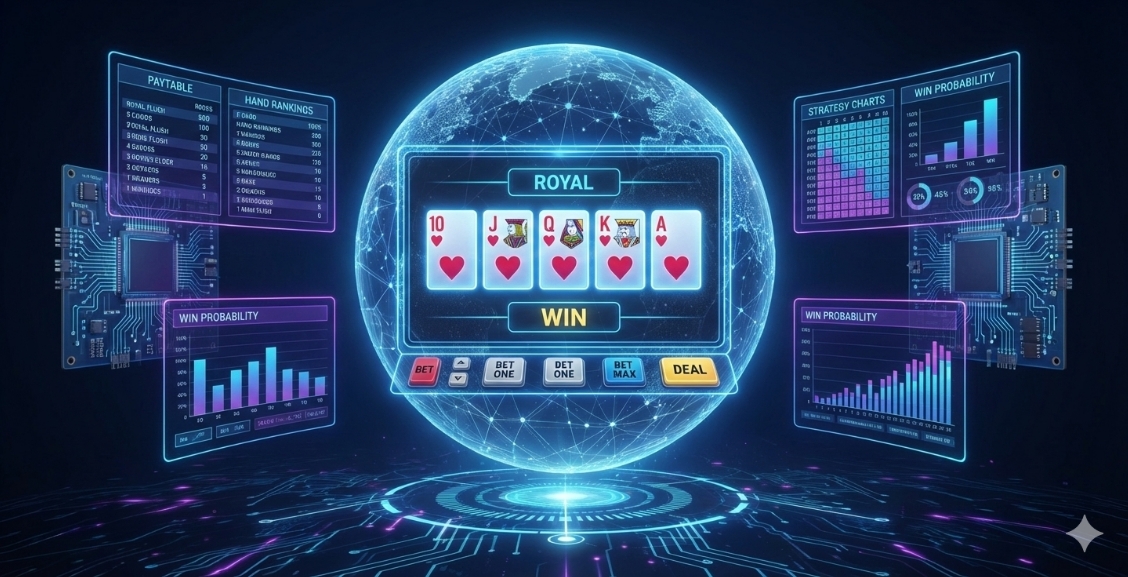
Video poker is a single-player card game based on five-card poker. You’re not playing against a dealer or other players. You’re playing against a paytable.
Every hand follows the same principle:
- the machine deals five cards
- you choose which cards to hold
- the machine replaces the rest
- the final hand is evaluated against the paytable
Your goal isn’t to beat another player—it’s to maximize payouts over time by making the best possible decisions.
The Basic Rules of Video Poker
While variants differ, the core rules stay consistent:
- Each hand starts with five cards
- You may hold any number of cards (0–5)
- Held cards stay; unheld cards are replaced
- The final hand determines the payout
There are no:
- bluffing mechanics
- betting rounds
- opponent decisions
Everything is transparent and rule-based.
Step-by-Step Gameplay Flow
1. Placing Your Bet
You choose:
- coin value
- number of coins (usually 1–5)
Many machines reward max-coin bets with higher top payouts.
2. The Initial Deal
The machine deals five cards instantly.
At this point:
- the outcome is not final
- your decisions matter
This is where skill begins to play a role.
3. Choosing Which Cards to Hold
You decide:
- which cards to keep
- which to discard
This decision:
- affects the final hand
- directly impacts RTP
Optimal strategy guides this choice.
4. The Draw
The machine replaces discarded cards with new ones.
Once this happens:
- the hand is complete
- no further decisions are possible
5. Payout Evaluation
The final hand is compared to the paytable, which determines:
- whether you win
- how much you’re paid
No hidden adjustments occur after the draw.
How Video Poker Machines Determine Hands
Video poker machines use a Random Number Generator (RNG).
Important points:
- each hand is independent
- previous hands don’t affect future ones
- timing doesn’t matter
The RNG selects card combinations randomly before your choices—but your holds decide which of those outcomes you end up with.
Why Decisions Matter More Than in Slots
Slots:
- determine outcomes fully at spin
- ignore player input
Video poker:
- deals random cards
- lets players influence the result
This difference explains why strategy plays such a large role in video poker outcomes.
The Role of the Paytable
The paytable defines:
- which hands pay
- how much each hand pays
- overall RTP
Two machines with the same name can:
- look identical
- play identically
- return very different amounts
Always check the paytable before playing.
Common Video Poker Variants (Mechanics Stay the Same)
Popular variants include:
- Jacks or Better
- Deuces Wild
- Bonus Poker
- Joker Poker
What changes:
- hand rankings
- payout values
- optimal strategy
What stays the same:
- gameplay flow
- RNG mechanics
- decision structure
What “Skill” Really Means in Video Poker
Skill does not mean:
- predicting cards
- memorizing outcomes
- beating the RNG
Skill means:
- consistently choosing the best hold
- minimizing expected loss
- maximizing long-term return
Mistakes don’t show immediately—but they add up.
Why Max Coins Are Often Important
Many machines:
- only pay the full royal flush bonus at max coins
Playing fewer coins:
- reduces top payout
- doesn’t reduce volatility
This creates a risk-reward decision every session.
How Volatility Fits Into Gameplay
Some video poker games:
- pay smaller wins frequently
- feel smoother
Others:
- rely heavily on big hands
- produce longer losing streaks
Mechanics don’t change—but emotional experience does.
Common Beginner Misunderstandings
New players often assume:
- machines get “hot”
- hands are “due”
- faster play changes odds
None of these affect outcomes.
Each hand is random and independent.
Why Video Poker Feels Slower Than Slots
Video poker feels slower because:
- decisions take time
- thinking is rewarded
- pace depends on the player
This slower pace is part of why disciplined players prefer it.
What Video Poker Machines Don’t Do
Machines do not:
- adjust payouts mid-session
- react to player behavior
- change odds based on time
Everything is fixed by design.
FAQs on How Video Poker Works
Is Video Poker Random?
Yes. Cards are dealt randomly, every hand.
Do My Choices Really Matter?
Yes. Decisions determine which outcomes you realize.
Can the Machine Change Odds?
No. Odds are fixed by the paytable and RNG.
Is Video Poker Hard to Learn?
The rules are easy; strategy takes practice.
Is Video Poker Better Than Slots?
For control and transparency, yes—if you play correctly.
Where To Go Next
Now that you understand how video poker works mechanically, the next step is comparing it directly to slots to see why the experience—and math—are so different.
Next Article: The Difference Between Video Poker and Slot Machines
Next Steps
If you want comparisons, read: The Difference Between Video Poker and Slot Machines
If you want fundamentals next, read: Understanding Video Poker Hand Rankings With Examples
Want the full context? Use: The Complete Guide to Video Poker
Gridzy Hockey is Shurzy’s daily NHL grid game where you pretend you’re “just messing around” and then suddenly you’re 15 minutes deep arguing with yourself about whether some 2009 fourth-liner qualifies as a 40-goal guy.
If you think you know puck, prove it. Go play Gridzy right now!